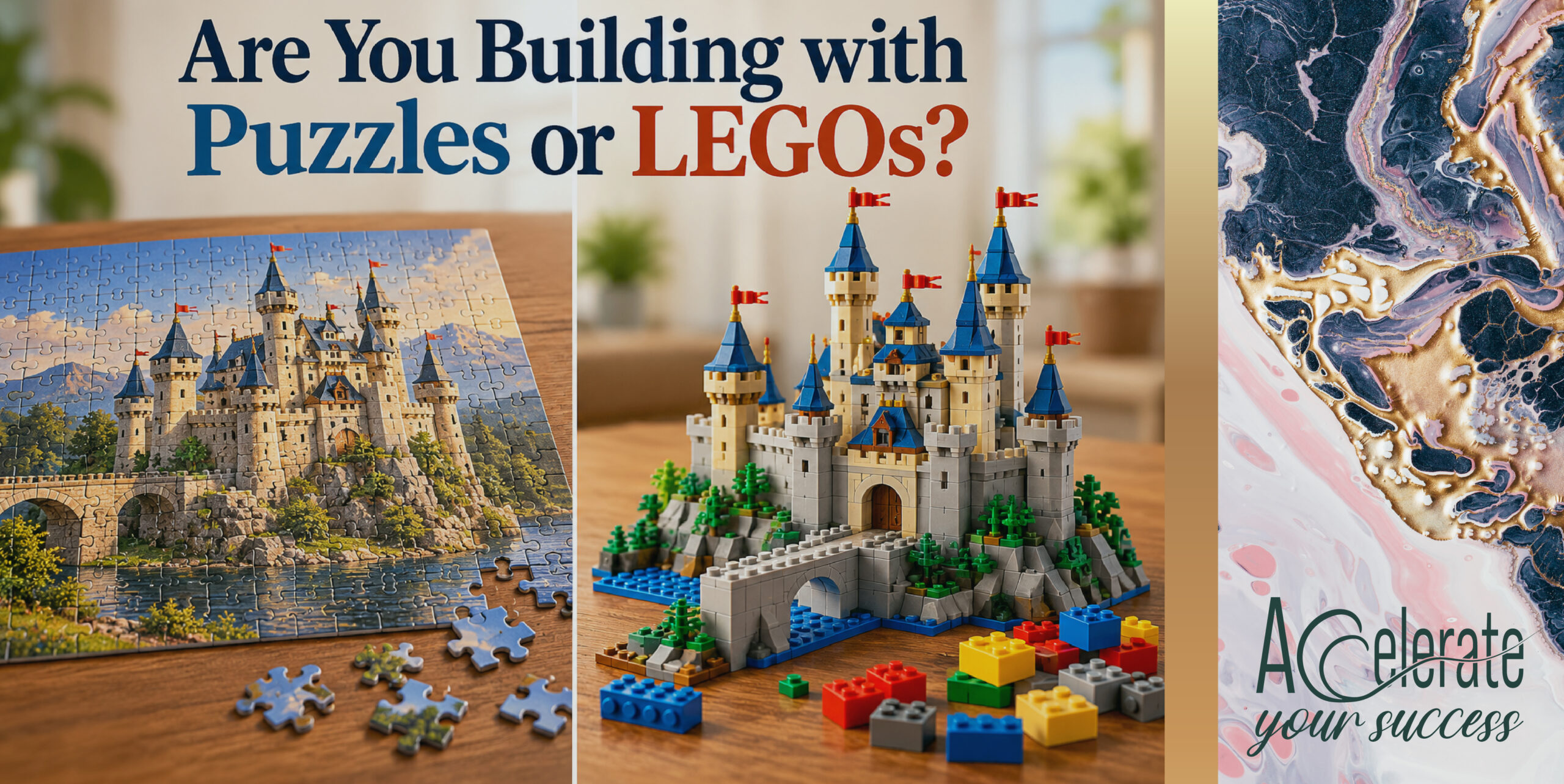
Imagine you’ve got two boxes sitting on the table. One contains a jigsaw puzzle, and the other contains a LEGO set. Both boxes have a picture of a beautiful castle on the front. Either one could be a wonderful way to spend a rainy afternoon. Both require some patience, attention, and problem-solving. And when you’re finished, you can step back and admire the castle you’ve created.
But there’s a fundamental difference between the two. With the jigsaw puzzle, there’s only one possible outcome. Every piece has a specific place, and when you put all the pieces together correctly, you end up with the castle pictured on the box. You can take it apart and put it together a hundred times, but you’re always going to end up with the same castle.
With the LEGOs, you can follow the instructions and build the castle pictured on the box. But you don’t have to. You could build a house, a bridge, a spaceship, or something nobody has ever thought of before. You could build the castle today, take it apart tomorrow, and create something entirely different next week. And if you bought another LEGO set, you could combine those pieces with the ones you already have and expand the possibilities even further.
The picture on the jigsaw puzzle box shows you what you must build. The picture on the LEGO box shows you just one thing you could build. I think that’s a distinction worth considering when we think about how we operate our businesses.
The Picture on the Box
Most business owners begin with some idea of what they want their business to look like. They know what products or services they want to offer, who they want to serve, and how they expect the business to operate. They develop systems, establish processes, hire employees, and make decisions that help them create the business they’ve envisioned. In other words, they start with a picture on a box.
And that’s a good thing. It’s difficult to build a successful business without some sense of what you’re trying to accomplish. But something interesting can happen as the business grows. The systems that were originally created to help the business accomplish its goals become the way things are done. The responsibilities that were assigned to particular people become the way the organization is structured. The products and services that made the business successful become the things the business is expected to provide.
Over time, we can become so accustomed to the way we’ve assembled everything that we stop recognizing that other arrangements are possible. What began as a collection of LEGOs starts looking more and more like a jigsaw puzzle.
When the Castle Becomes the Goal
Think about the difference between building a castle because that’s what you want to create and building a castle because that’s what the instructions tell you to build. The finished product might look exactly the same, but the thinking behind it is very different. In the first situation, you’ve made a choice. You’ve considered the possibilities and decided that the castle is what you want. In the second, you’ve accepted the castle as the only outcome worth pursuing.
Businesses can fall into that second way of thinking without ever making a conscious decision to do so. A company may continue offering a service because it’s always offered that service, even though customer needs have changed. A process may remain in place because it has worked for years, even though the technology and resources available to the business are dramatically different. An organizational structure may be preserved because everyone knows where they fit, even when that structure no longer supports what the company is trying to accomplish.
None of those decisions is necessarily wrong. Sometimes the existing service, process, or structure really is the best choice. The problem arises when we stop recognizing that it’s a choice at all. When that happens, our attention shifts away from asking what we want to accomplish and toward figuring out how to preserve what we’ve already built. We become very good at maintaining the castle without ever asking whether the castle is still what we want or need.
What Are We Actually Working With?
Here’s what makes the LEGO comparison particularly interesting to me. The pieces themselves don’t dictate what has to be built. A rectangular LEGO brick might become part of a castle wall, a bridge support, or the foundation of a spaceship. Its usefulness isn’t limited to the purpose it served in the original design.
But once we’ve assembled those pieces into something recognizable, it’s easy to begin thinking of them in terms of what they’ve become rather than what they are. We see a wall instead of the individual bricks. We see a tower instead of the collection of pieces that makes the tower possible. And in business, we do something very similar.
We see departments, positions, procedures, and established ways of serving customers. Those are the structures we’ve built, and they can be so familiar that we forget they’re made up of individual capabilities, resources, and decisions. The structure is real, and it may be extremely valuable. But it isn’t necessarily the only structure those pieces could support.
That distinction matters because a business isn’t a finished picture. It’s an organization operating in a world that keeps changing. Customers develop different expectations. Technology makes new things possible. Employees gain experience. Markets shift. Opportunities appear that weren’t available when the business was first established.
The pieces we have today may be capable of supporting something we couldn’t have imagined when we first started building. But we have to be willing to see them as pieces rather than permanent parts of a completed picture.
You Don’t Have to Tear Down the Castle
I want to be clear about something: I’m not suggesting that every business needs to reinvent itself. There’s a lot to be said for consistency, stability, and doing something exceptionally well. If you’ve built a successful business that serves your customers, supports your employees, and accomplishes what you want it to accomplish, there’s no reason to dismantle it just because you could build something different.
A LEGO castle can remain a castle for as long as you want it to. The important difference is knowing that it doesn’t have to. When you understand that you’re working with LEGOs, you can make a deliberate decision to keep the structure you’ve created. You can improve it, expand it, or leave it exactly as it is.
And when something changes, you have options. You aren’t limited to searching for a replacement piece that fits a predetermined opening. You can consider whether a different arrangement might work better. You can recognize that the resources you’ve already invested in may be useful in ways you haven’t explored. You can decide what you want to build next rather than assuming the picture on the box is the only acceptable outcome.
What’s on Your Box?
I’d encourage you to think about your own business for a moment. When you picture it, what do you see? Do you see the company as it exists today, with its established roles, systems, products, and services? Or do you also see the underlying capabilities that make all those things possible?
How many of the decisions you make are based on what you’re trying to accomplish, and how many are based on maintaining the way things have always been done? There’s nothing wrong with building the castle pictured on the box. It may be exactly the right castle for you. But if you’re working with LEGOs, that picture represents a possibility, not a limitation.
Are you building the business you want, or are you simply maintaining the picture on the box?