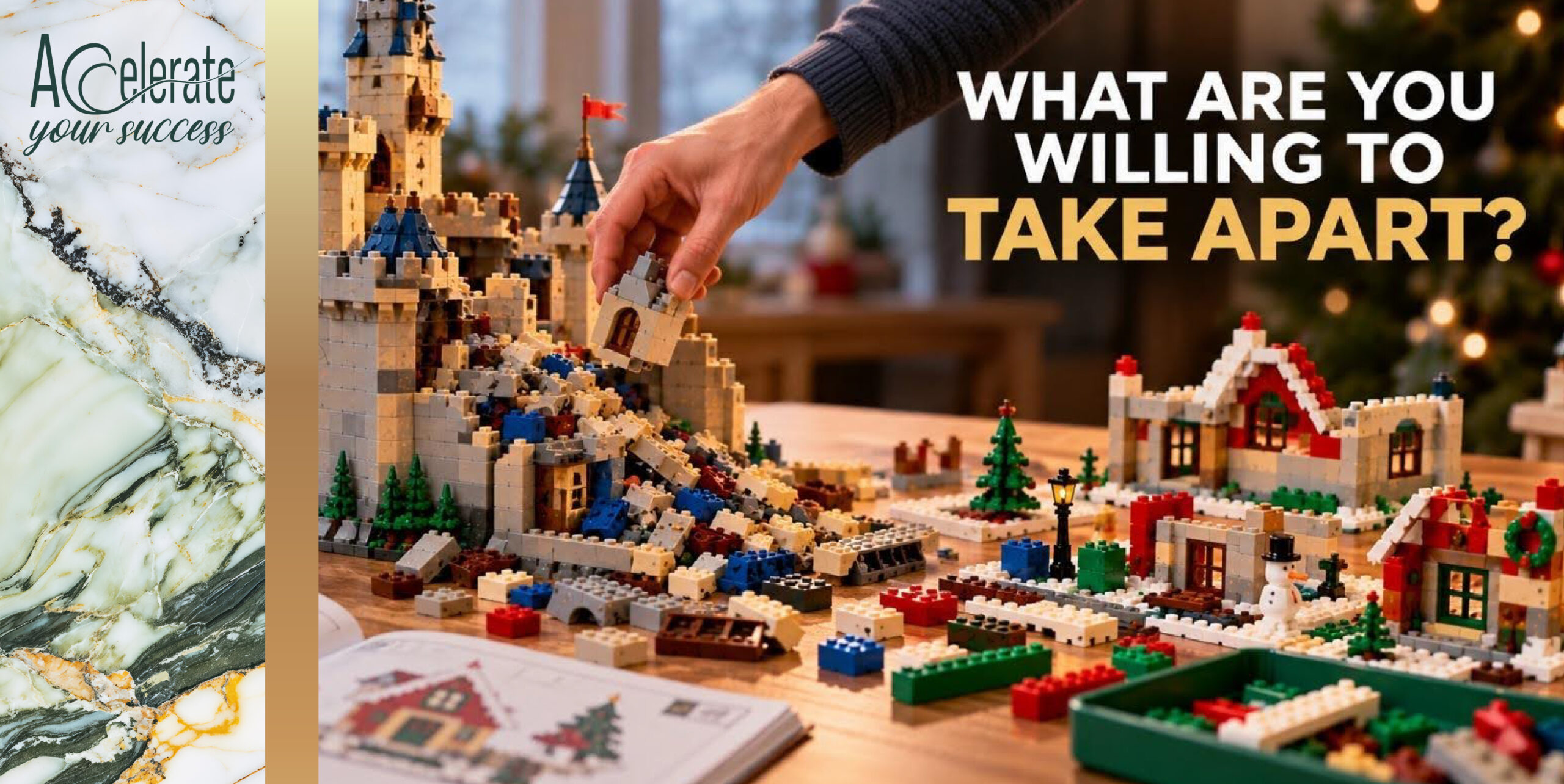
Imagine you’ve spent months building an elaborate LEGO castle. It has towers, walls, a drawbridge, and all sorts of interesting details. You’ve invested considerable time in it, you’re pleased with how it turned out, and it looks wonderful sitting on display.
Now the holidays are approaching, and you decide you’d like to build a Christmas village. You picture little shops, houses with snow-covered roofs, a town square, and a Christmas tree surrounded by colorful buildings. You can already imagine how wonderful it’s going to look.
There’s just one problem. Most of your LEGOs are already being used in the castle.
You could buy more LEGOs, of course, but suppose that’s not an option. You have to work with the pieces you already own. You can build a smaller village than you imagined, or you can take apart some of the castle and use those pieces to create something new. What you can’t do is use the same LEGO brick in two places at once.
I think that’s a pretty good illustration of what happens in our lives and businesses, particularly around the holidays.
We Keep Adding Without Taking Anything Away
For most of the year, we operate within routines we’ve established. We have work responsibilities, family commitments, household tasks, community activities, and all the other things that fill our days. We’ve arranged the pieces of our lives into a structure that more or less works, even if we occasionally feel as though we’re running out of room.
Then the holidays arrive, and we start imagining all the things we’d like to do. We want to spend more time with family, decorate our homes, attend holiday events, prepare special meals, visit friends, and participate in traditions that are meaningful to us.
At work, there may be year-end projects to complete, customers who need attention, employees requesting vacation time, holiday celebrations to organize, and plans to make for the coming year. For some businesses, the holidays also bring the busiest selling season of the year. None of these things is necessarily unreasonable. Most of them are things we genuinely want to do or responsibilities we consider important. The problem is that we’re trying to add all of them to schedules that were already full.
We want to build the Christmas village, but we don’t want to take apart the castle.
We try to make everything fit. We work longer hours, sacrifice sleep, rush from one commitment to another, and squeeze holiday activities into whatever spaces we can find. We may manage to accomplish everything on our list, but somewhere along the way, the experiences we were looking forward to become additional obligations.
Sometimes we reach the end of the holiday season wondering why something that was supposed to be enjoyable felt so exhausting.
The Pieces We Have Are Limited
When we’re talking about LEGOs, the limitation is easy to understand. If you have fifty bricks and forty-five of them are already being used, you only have five available for something new.
Our time, energy, attention, and financial resources work much the same way, although we aren’t always as realistic about their limitations.
We can sometimes increase our available resources. We might hire additional help, delegate responsibilities, purchase something rather than make it ourselves, or use technology to reduce the time a task requires. Those are legitimate ways to create more capacity. But there are limits to what we can add. We can’t manufacture more hours in the day, and we can’t continually extend our working hours without eventually affecting our health, relationships, or ability to perform well.
This is particularly important for business owners, because the boundaries between business responsibilities and personal time can be remarkably easy to move. If something needs to be done, we can simply work another hour. And then another. Those hours have to come from somewhere.
An extra evening spent catching up on work may mean missing a family activity. Taking on another holiday obligation may mean giving up an evening we could have spent relaxing. Agreeing to one more project may mean having less attention available for the people and responsibilities that already depend on us.
The issue isn’t necessarily that we’re making bad choices. It’s that we sometimes make those choices without acknowledging what we’re giving up in exchange. Every LEGO we use for one part of the structure is a LEGO that isn’t available somewhere else.
Just Because You Built It Doesn’t Mean You Have to Keep It
Here’s where I think the LEGO analogy becomes particularly useful.
Imagine looking at your castle and deciding which pieces you’re willing to remove. Perhaps you take down one of the towers. Maybe you eliminate a section of the outer wall or decide that the drawbridge doesn’t need to be quite so elaborate.
You’re not saying the castle was a mistake. It may have been exactly what you wanted to build when you started. You may have enjoyed every minute of creating it. What you want to build now is different, and you’re willing to change something you’ve already created to make room for it.
We don’t always approach our commitments with that same flexibility.
Maybe you’ve hosted the family holiday dinner for twenty years. You started doing it because you loved bringing everyone together, and for a long time, it was one of your favorite traditions. But your circumstances have changed. The preparation now takes more energy than you want to devote to it, and you spend much of the gathering working in the kitchen rather than enjoying your family.
Does continuing to host the dinner exactly as you’ve always done still accomplish what you wanted it to accomplish? Perhaps someone else could host. Maybe everyone could contribute part of the meal. Or perhaps the family could establish a completely different tradition that allows everyone to spend more time together.
The same question applies to our businesses. Maybe you’ve always held an elaborate employee holiday party, but the planning has become increasingly expensive and time-consuming. Perhaps your employees would actually prefer a simpler gathering, an additional afternoon off, or something entirely different.
Or maybe your business has developed a habit of accepting every last-minute customer request during December, even when doing so requires employees to work evenings and weekends. That may have made sense when the business was smaller or when you were trying to establish your reputation. But is it still the right approach today?
We often continue doing things because they’re part of the structure we’ve already built, without stopping to ask whether they’re still contributing what we intended. Sometimes the best way to make room for something important is to change something that used to be important.
What Are You Actually Trying to Build?
Before you start taking bricks off the castle, it helps to know what you want your Christmas village to look like. The same is true when we’re making decisions about our time and commitments. If we haven’t thought about what we want to create, it’s difficult to decide which existing responsibilities deserve to remain and which ones we’re willing to change.
Suppose you say that spending meaningful time with your family is one of your priorities during the holidays. What does that actually mean? Does it mean attending every event together? Hosting a large gathering? Having a few uninterrupted evenings at home? Taking a trip? Or simply being available without constantly checking your phone?
Those are very different pictures, and each requires a different arrangement of the pieces. For a business owner, the question may be how to keep the business operating successfully while creating opportunities for employees to enjoy time away. That could mean planning vacation coverage earlier, adjusting project deadlines, communicating holiday schedules to customers, or temporarily changing what the business offers.
None of those decisions happens automatically. They require us to determine what matters most and organize our resources accordingly. Sometimes we discover that we’ve been investing considerable time and energy in things that aren’t especially important to anyone anymore. That’s worth knowing, because those may be exactly the bricks we need for something else.
You Don’t Have to Dismantle the Entire Castle
There’s another part of this analogy I don’t want us to overlook. Making room for something new doesn’t necessarily require abandoning everything we’ve already built.
You may love your castle and want to preserve most of it. Perhaps removing one tower gives you enough bricks to begin the village. Maybe you can redesign part of the castle so it uses fewer pieces without losing the things you value most about it.
The objective isn’t to take everything apart. It’s to recognize that the structure isn’t permanent simply because we’ve already assembled it.
In our businesses, that might mean changing a schedule, eliminating a meeting, delegating a responsibility, or reconsidering a tradition that no longer serves its original purpose. In our personal lives, it might mean simplifying a celebration, declining an invitation, or deciding that something we’ve always done doesn’t need to happen this year.
Sometimes those changes are small. Sometimes they’re substantial. But they begin with the willingness to question whether the way we’ve arranged our resources still reflects what we want to accomplish.
That question doesn’t apply only to the holidays. We can spend years building careers, businesses, routines, and responsibilities that make perfect sense at the time. Then our circumstances change, our priorities evolve, or we discover something new we’d like to pursue. If every brick remains committed to what we’ve already built, we leave ourselves very little room to create anything different.
As the holidays approach, perhaps the most useful question isn’t how we’re going to fit everything into an already-full schedule.
It’s what we’re willing to take apart to make room for what we really want to build.