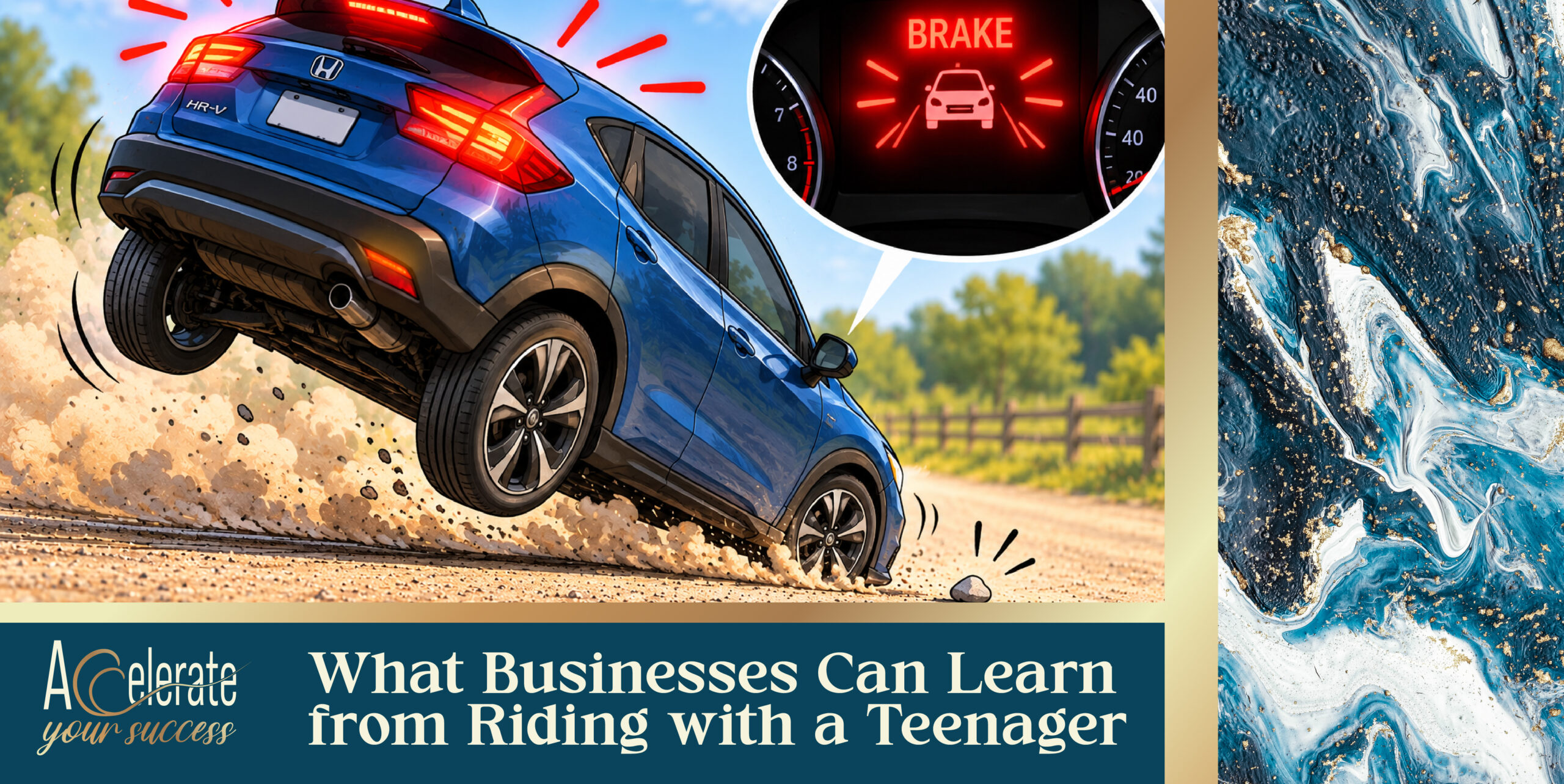
This month marks the 40th anniversary of getting my driver’s license. Forty years! I still remember the incredible sense of freedom that came with it. Suddenly, if I wanted to go somewhere, I could just go. I didn’t have to ask someone to take me, coordinate schedules, or figure out who might be available. I could get in a car, turn the key, and leave. There’s something extraordinary about that kind of independence when you’re a teenager. The world doesn’t necessarily get any bigger, but your ability to explore it certainly does.
Of course, first I had to learn to drive and I learned in Los Angeles. For those of you who have never had the pleasure of driving in LA traffic, let me assure you that it provides plenty of opportunities to practice your reflexes.
I particularly remember people merging into traffic in front of me. Someone would pull into my lane, and my immediate reaction was, Oh my God! They’re going to hit me! I’d slam on the brakes, only to discover that the other driver was actually traveling faster than I was. Eventually, I figured out that if I simply maintained my speed or adjusted it appropriately, there would be plenty of room between us. I didn’t need to panic every time another car entered my lane.
It took experience to learn that. Eventually, judging the movement of other vehicles became something I did almost automatically. Years later, when I taught my stepchildren to drive, I got to watch some of that learning process from the other side. And now, forty years after getting my license, I’m experiencing it all over again.
Apparently, my new Honda is learning to drive.
I love my car. I really do. It has all sorts of wonderful technology designed to make driving safer, easier, and more comfortable. But sometimes I feel like I’m riding around with a sixteen-year-old who has just gotten a learner’s permit.
Take the cruise control. For decades, cruise control was a relatively straightforward proposition. You set the speed, and the car maintained that speed. Simple. Now my car has adaptive cruise control, which means it watches the traffic ahead and adjusts my speed to maintain a safe distance. In theory, that’s fabulous. In practice, it occasionally reminds me of myself driving through Los Angeles forty years ago.
Someone merges into my lane, and my car apparently thinks, OH MY GOD! WE’RE GOING TO DIE! Suddenly, there’s a giant, bright, flashing red BRAKE warning on the dashboard. It’s wonderfully dramatic, and I’m sitting there thinking, Honey, it’s okay. They’re going faster than we are. We don’t need to panic. I’ve said this before, except last time, I was the teenager.
Then there are the sensors. I live on a dirt road in Mississippi, and apparently nobody thought to explain dirt roads to my car. Periodically, it gets terribly concerned because it can’t find the lines on the road. It seems convinced that I’m not staying in my lane. Well, sweetheart, there aren’t any lines. We’re doing the best we can.
And then there’s the dew. On mornings when the sensors are covered with moisture, my car repeatedly informs me that it can’t see properly and that I need to clean things off. Every few seconds, another reminder. I can practically hear it saying, Excuse me. Excuse me! I can’t see. Would you please get out and polish my glasses?
What’s particularly entertaining is that when the sensors can’t see, the cruise control isn’t available. I’ve been using cruise control for years without needing a camera, a radar system, or a perfectly clean windshield. But now that my cruise control is considerably more intelligent, there are circumstances when it can’t do the basic job the old system handled without complaint.
I find all of this genuinely funny. I’m not angry with my car, and I certainly wouldn’t trade it for the one I drove forty years ago. I recognize that these technologies have the potential to prevent accidents and save lives. But I also wonder how many of the people who designed these systems have ever driven down a dirt road in Mississippi on a dewy morning.
I’m sure the technology works beautifully under the right conditions. Give it a highway with clearly painted lines, clean sensors, and predictable traffic, and it probably performs exactly as intended. But that’s not necessarily the environment in which the customer is going to use it.
That brings me to software updates. You know the ones. You open a program you’ve been using for years, and suddenly nothing is where you left it. Somebody has decided that the button you’ve clicked approximately 10,000 times would be much better located three menus over, underneath an icon that looks nothing like what you’re trying to accomplish.
Somewhere, there’s probably a software developer who’s very proud of how much they’ve improved the user experience. Meanwhile, I’m sitting at my computer wondering why I now need a treasure map to accomplish something I could do yesterday without thinking about it.
The developer knows exactly where the button is. Of course the new interface is easy to use! They’ve been working with it for months. They understand the logic behind the changes, know how the features interact, and can navigate the entire program without hesitation. But the customer doesn’t have that knowledge. The customer just wants to get something done.
I think that’s where businesses get themselves into trouble.
What Is the Customer Actually Experiencing?
We spend so much time inside our businesses that we forget what they look like from the outside. We understand our systems, our procedures, and the reasons we do things the way we do. We know what information is needed, what happens next, and how long things usually take. Because it all makes sense to us, we assume it makes sense to our customers.
But does it?
Think about what happens when someone walks into your office for the first time. You know where they’re supposed to check in. You know whether they need to sign a form, speak to the receptionist, or wait for someone to come get them. You know that the person they’re meeting with is finishing another appointment and will be out in a few minutes.
But what does the customer know? Is it obvious where they’re supposed to go? Does someone acknowledge them when they walk through the door? If they’re asked to sit down, do they know whether they’re going to be waiting two minutes or twenty? Are they wondering whether they’ve been forgotten?
From inside the business, everything may be running exactly as planned. From the customer’s perspective, the experience may be confusing, uncomfortable, or unnecessarily frustrating.
Or consider a company that sends technicians to customers’ homes. The dispatcher knows that the technician’s previous appointment took longer than expected. The technician knows he’s running behind. The office knows he’s still coming and that he’ll probably arrive sometime in the next hour.
But the customer doesn’t know any of that.
The customer knows that someone was supposed to arrive between nine and eleven, and it’s now eleven-thirty. They’ve rearranged their schedule to be home. They don’t know whether they have time to run an errand, whether they should call the office, or whether anyone is coming at all. They may be getting increasingly irritated while everyone at the company assumes things are going just fine.
When the technician finally arrives and completes the repair, the company may consider the appointment a success. The work was done correctly, the customer was charged the agreed-upon price, and the technician moved on to the next job.
But was it a good customer experience? That’s a very different question.
The company is evaluating what it accomplished. The customer is evaluating what it was like to do business with the company. Those two perspectives don’t always produce the same answer.
The Problem With Knowing Too Much
One of the challenges of running a business is that the better we understand how it operates, the harder it can become to see what our customers don’t understand.
We know why our website is organized the way it is. We know which department handles which questions. We know why customers have to fill out certain forms, why appointments are scheduled in particular ways, and why some requests take longer than others.
And because we know all of those things, we can navigate the experience without difficulty. We don’t have to wonder what happens next because we already know.
It’s a little like the software developer who can’t understand why anyone would have trouble finding the button. Or the automotive engineer who has tested a system on hundreds of miles of beautifully marked highways but hasn’t considered what happens when the pavement ends.
The problem isn’t necessarily that anyone has done a poor job. The developer may have created an excellent program. The engineer may have designed a genuinely valuable safety feature. The service company may have an efficient scheduling system.
The problem is that they’re evaluating the experience from a position of knowledge the customer doesn’t have. And that knowledge can create blind spots.
Sometimes we make assumptions about what customers know. Sometimes we don’t realize how much effort we’re asking them to put into something. Sometimes we design processes that make life easier for our employees without considering whether those same processes make life more difficult for the people we’re serving.
Sometimes we simply don’t know there’s a problem because nobody has told us. Not every frustrated customer complains. Some people figure out a workaround. Some decide the inconvenience isn’t worth mentioning. Some laugh about it, the way I laugh about my car. And some quietly decide to do business somewhere else.
If we’re relying entirely on complaints to tell us whether customers are having a good experience, we’re probably missing a great deal.
Have You Ever Been Your Own Customer?
I wonder how often business owners actually experience their businesses the way their customers do. Not by reviewing the procedures they’ve established or asking employees whether everything is working properly. Not by looking at reports that tell them how quickly calls are answered or how many appointments are completed. I mean genuinely experiencing what it’s like to do business with their company.
What happens when someone visits your website and doesn’t already know where to find what they’re looking for? What happens when they call your office with a question that doesn’t fit neatly into one of your standard categories? What does your billing process look like to someone who doesn’t understand your accounting system? What happens when things don’t go exactly according to plan?
That’s the part I think we particularly need to understand. It’s relatively easy to design a process that works under ideal conditions. It’s much harder to anticipate all the different circumstances in which real customers will encounter it.
Forty years ago, I had to learn how to drive in the real world, with all its unpredictability. I couldn’t become a good driver simply by understanding how the car was supposed to work. I had to experience traffic, make judgments, encounter situations I hadn’t anticipated, and gradually develop the ability to respond appropriately.
I think businesses need to approach customer experience with that same willingness to learn.
We can’t assume that because we’ve designed a process, we understand what it’s like to use it. We can’t assume that because our employees know how something works, our customers will find it intuitive. And we can’t assume that because a transaction was completed successfully, the customer had a good experience.
We have to be willing to look at our businesses from the outside, without all the knowledge and familiarity that make everything seem so simple from the inside.
I love my Honda, even when it gets a little dramatic about traffic or insists that I need to clean its glasses. And I appreciate the engineers who are working to make driving safer. But I suspect they’d learn something useful if they spent a few mornings driving down my dirt road.
Which makes me wonder: What would you discover if you experienced your business the way your customers do?